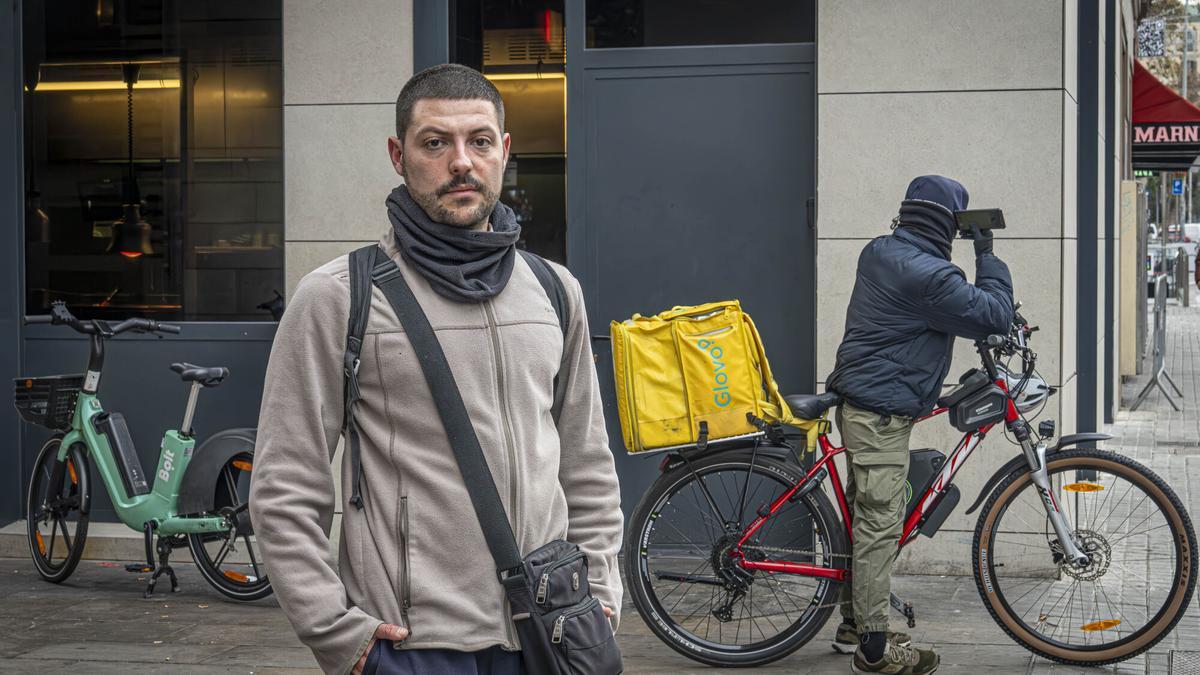
David Martínez, a Glovo Delivery Worker: Fired for Visiting His Hospitalized Mother
Gabriel Ubieto Barcelona 25 DEC 2025 13:02
David Martínez has been delivering for Glovo for six years. He has firsthand witnessed the transformation of a sector that has lived between rounds of million-dollar financing and massive labor conflicts. Conflicts that, despite the change in the labor model announced by Glovo a year ago to this date, do not cease. Martínez was fired a few days ago for being absent from his job for a few days. The algorithm did not correctly register that this delivery worker had requested leave due to a family member's hospitalization - whose certificate he shows to this newspaper - and was absent because he was taking care of his mother. And the app, without further context, executed his dismissal.
"I communicated it, in writing, to my supervisor and then another person called me who said they knew nothing. They have total disarray and it suits them well to keep firing delivery workers because they must have excess staff. Out of 10 they fire, maybe four will claim, because it takes more than a year to go to trial and many cannot afford it or do not want trouble," explains this delivery worker.
"Before taking any disciplinary action, the company sends several notifications to the delivery worker explaining the situation. In addition, the delivery worker can submit a claim through the company's Human Resources channels for any situation they consider does not fit their job performance. A specialized team reviews the claim and the documentation provided in all cases, proceeding of course to rectification when appropriate," states Glovo, in response to questions from this media.
Martínez has stood out in the delivery sector as an affiliate of the CGT. Is his dismissal a retaliation for such union activity? He is not certain, nor does he rule it out. In fact, another colleague of his from the union, also very prominent in the sector, was fired at the end of October also for being absent from his job. The reason? He had a motorcycle accident and the Social Security delayed in sending the sick leave to the company. Glovo immediately executed the dismissal, although the next day it readmitted him upon realizing the illegality committed.
Two days after Martínez shared his story with EL PERIÓDICO and the same day this media contacted the company to gather their version of the events, Glovo called this messenger to acknowledge their mistake and tell him that they can revoke his dismissal, as he explains. "The damage is already done and the lawsuit is already filed," Martínez replies.
His hypothesis does not sound far-fetched to Franz Morales, coordinator of the platform sector of CCOO of Catalonia. "We see how among the subcontracted fleets offers are coming out and not in Glovo," he claims. Currently, according to data consulted by the union from Social Security, only in the province of Barcelona Glovo employs 5,148 people, between offices and delivery.
"This type of behavior does not derive from the labor model, but from the company's culture," explains Ferran Muntané, researcher at the UPF. Food delivery workers, for their part, often report back pain and joint pain due to carrying heavy loads and climbing stairs. Likewise, their irregular schedules make it difficult to maintain healthy habits, often leading them to skip meals or to resort only to fast food due to lack of time. Beyond the physical challenges, food delivery workers face pressures that lead them to take risks to meet the strict delivery times set by the platforms.
David Martínez has been delivering for Glovo for six years. He has firsthand witnessed the transformation of a sector that has lived between rounds of million-dollar financing and massive labor conflicts. Conflicts that, despite the change in the labor model announced by Glovo a year ago to this date, do not cease. Martínez was fired a few days ago for being absent from his job for a few days. The algorithm did not correctly register that this delivery worker had requested leave due to a family member's hospitalization - whose certificate he shows to this newspaper - and was absent because he was taking care of his mother. And the app, without further context, executed his dismissal.
"I communicated it, in writing, to my supervisor and then another person called me who said they knew nothing. They have total disarray and it suits them well to keep firing delivery workers because they must have excess staff. Out of 10 they fire, maybe four will claim, because it takes more than a year to go to trial and many cannot afford it or do not want trouble," explains this delivery worker.
"Before taking any disciplinary action, the company sends several notifications to the delivery worker explaining the situation. In addition, the delivery worker can submit a claim through the company's Human Resources channels for any situation they consider does not fit their job performance. A specialized team reviews the claim and the documentation provided in all cases, proceeding of course to rectification when appropriate," states Glovo, in response to questions from this media.
Martínez has stood out in the delivery sector as an affiliate of the CGT. Is his dismissal a retaliation for such union activity? He is not certain, nor does he rule it out. In fact, another colleague of his from the union, also very prominent in the sector, was fired at the end of October also for being absent from his job. The reason? He had a motorcycle accident and the Social Security delayed in sending the sick leave to the company. Glovo immediately executed the dismissal, although the next day it readmitted him upon realizing the illegality committed.
Two days after Martínez shared his story with EL PERIÓDICO and the same day this media contacted the company to gather their version of the events, Glovo called this messenger to acknowledge their mistake and tell him that they can revoke his dismissal, as he explains. "The damage is already done and the lawsuit is already filed," Martínez replies.
His hypothesis does not sound far-fetched to Franz Morales, coordinator of the platform sector of CCOO of Catalonia. "We see how among the subcontracted fleets offers are coming out and not in Glovo," he claims. Currently, according to data consulted by the union from Social Security, only in the province of Barcelona Glovo employs 5,148 people, between offices and delivery.
"This type of behavior does not derive from the labor model, but from the company's culture," explains Ferran Muntané, researcher at the UPF. Food delivery workers, for their part, often report back pain and joint pain due to carrying heavy loads and climbing stairs. Likewise, their irregular schedules make it difficult to maintain healthy habits, often leading them to skip meals or to resort only to fast food due to lack of time. Beyond the physical challenges, food delivery workers face pressures that lead them to take risks to meet the strict delivery times set by the platforms.
Additional Information (Preview)
The situation of David Martínez illustrates a broader problem in the gig economy or the economy of temporary and on-demand jobs, especially regarding the working conditions of delivery workers. The gig economy has grown exponentially in the last decade, driven by technology and the demand for instant services. However, this model has been the subject of criticism and controversy, particularly concerning job security, workers' rights, and employment precarity. In various countries, digital platforms like Glovo have faced legal lawsuits and protests from workers demanding better labor classification. Many of these workers are classified as independent contractors, depriving them of basic labor rights such as minimum wage, regulated working hours, paid vacations, and protection against unfair dismissal. Martínez's case is not isolated. In the past, numerous situations have arisen where the algorithms managing work assignments and performance evaluations have...
This is a preview of additional information. Register to see the full text.
Source: Levante-EMV • All content and images belong to their respective owners.